
Resolved Case
Rassawek SAVED
- Victory — In March 2022, after a four-year battle, the Water Authority agreed to an alternate route, sparing Rassawek.
- About the Case
Protecting Rassawek: A Landmark Victory for the Monacan Indian Nation
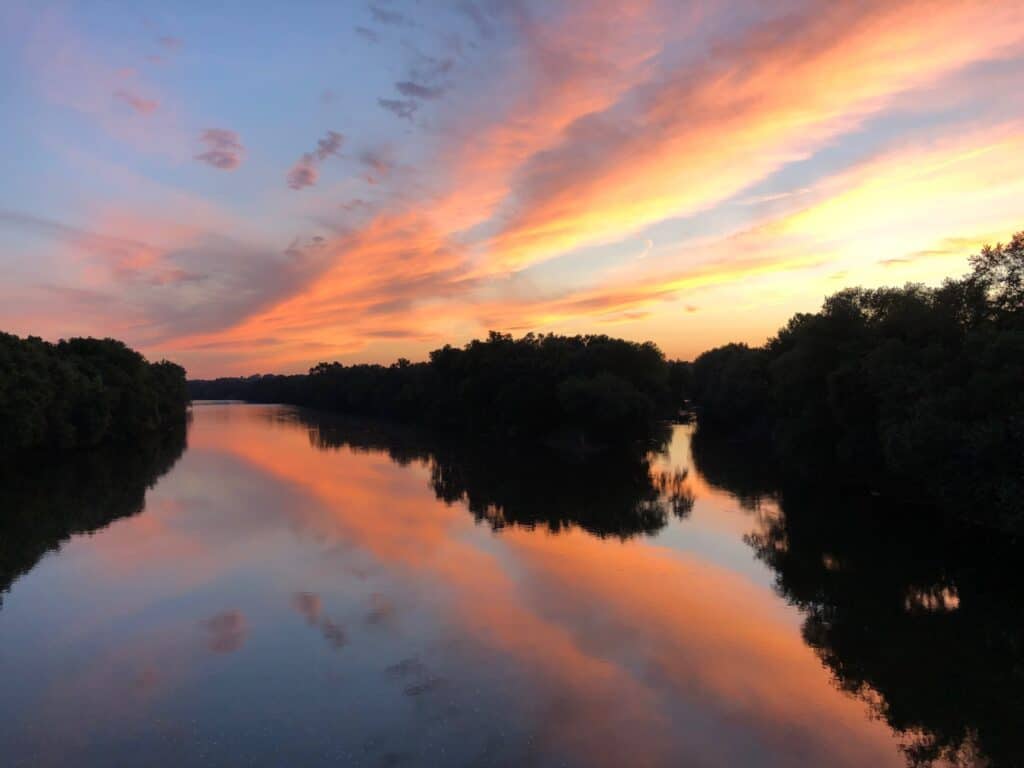
Rassawek, the ancestral capital of the Monacan Indian Nation, sits at the confluence of the James and Rivanna Rivers in Central Virginia.
From 2018 to 2022, Cultural Heritage Partners proudly represented the Monacan Indian Nation in their successful fight to protect their historic capital, Rassawek, from a water withdrawal and pump station project proposed by the James River Water Authority. During our four-year fight to oppose the JRWA project, we exposed flaws in the project’s environmental permitting and archaeological methods; represented the Nation in negotiations with federal, state, and local agencies and political leaders; built a broad coalition of Tribal Nations, preservation groups, faith communities, and environmental advocates; coordinated successful media outreach with journalists and scholars; and supported the Nation in related litigation with amicus briefs. This multifaceted strategy resulted in a significant win for the Nation and in 2022, after four years of pressure, the James River Water Authority agreed to investigate an alternative route identified by the Monacan Indian Nation.
What Was at Stake
Rassawek – The Monacan Capital
In opposing the James River Water Authority project, the Monacan Indian Nation fought to protect the cultural landscape of Rassawek, the sanctity of Monacan burials, and the archaeological value knowledge embedded in this sacred place. Rassawek, located at the confluence of the James and Rivanna rivers in central Virginia, was a site of central importance for the Monacan people beginning at least 4,730 years ago. By 1607, when John Smith mapped much of indigenous Virginia, Rassawek was the Monacan’s “chiefest town” to which other Monacan towns paid tribute. Beginning in the 1880s, Smithsonian anthropologists documented important archaeological resources and extensive human burials at Rassawek. Locating the JRWA project on top of Rassawek would have desecrated Monacan ancestors, caused enduring changes to the site’s setting and presence, and would have rushed and botched archaeological investigations of the highest sensitivity. To hear more about Rassawek’s importance from Monacan Chief Emeritus Kenneth Branham, watch the video below.
Sovereignty and Meaningful Tribal Consultation for Virginia Tribes
The Nation also fought for their rightful seat at the table as a federally-recognized Tribe entitled to meaningful and informed consultation from the Army Corps of Engineers, the Commonwealth of Virginia, and local governments. The Rassawek case was the first major test of tribal consultation rights since the 2016 and 2018 acknowledgements of Virginia’s seven federally-recognized Tribes. The JRWA had ignored early concerns from archaeologists about the sensitivity of the site and the Army Corps process did not initiate consultation with the Nation until they were considering a Memorandum of Agreement to conclude the Section 106 process under the National Historic Preservation Act.
Legal, Permitting, and Archaeological Issues in the Case
CHP identified significant legal, permitting, and cultural resources errors in our representation of the Nation. In 2020 the Nation filed a 1,124 page document with the Army Corps of Engineers outlining these concerns:
- JRWA and the Army Corps had illegally segmented project permitting, allowing construction of most of the water pipeline and water treatment plant under another permit application before initiating tribal consultation.
- The Army Corps had inappropriately evaluated the importance of the cultural resources harms from the project, and had erred in not requiring the project be permitted under an individual permit or requiring a robust alternatives analysis under NEPA.
- The Army Corps had failed to provide adequate opportunity for public comment because it failed to make the complete permit application available.
JRWA’s archaeological consultant had misrepresented her degree subject, causing the Virginia Department of Historic Resources to find her not qualified under the Secretary of Interior qualifications for archaeological research. - JRWA’s archaeological consultant had violated the project burial permit, lied to state officials, mischaracterized the resumes and expertise of field staff, and used construction workers and untrained archaeological staff to investigate the eligibility of sites.
- The archaeological research design for the data recovery had been plagiarized from a researcher studying another area of Virginia, used other consultants’ work against their will, mischaracterized the field methods in practice across the sites, and would have investigated less than 5% of the sensitive site before destroying it.
- The bad-faith and incompetent archaeological work conducted to date on the project represented anticipatory demolition of the site.
Building a Winning Coalition
CHP’s work in this case involved not only participation in consultation meetings and submitting comments, but in developing a responsive and motivated grassroots and grasstops advocacy strategy. We coordinated press coverage from local Virginia and national news outlets, resulting in close to one hundred articles in four years. We also coordinated with allies, advocates, and elected officials to ensure that a wide range of decisionmakers and stakeholders understood the key issues at stake in this case.
Ultimately, the Nation’s fight was strengthened by support from the National Congress of American Indians, United South and Eastern Tribes, Virginia’s six other federally recognized Tribal Nations, the Southern Environmental Law Center, Preservation Virginia, the Sierra Club, the Episcopal Diocese of Virginia, the Council of Virginia Archaeologists, and many others—including elected leaders such as Governor Ralph Northam, Senators Tim Kaine and Mark Warner, and Congressman Donald McEachin.
In 2020, Rassawek was named to both Preservation Virginia’s list of Virginia’s “11 Most Endangered Places” list and the National Trust’s list of “America’s 11 Most Endangered Historic Places.”
Where We Are Today
After the resounding Army Corps public comment, JRWA agreed to pause their permit application to explore the feasibility of an alternative route for their water withdrawal project. Called “Alternative 1C” in the alternatives analysis, this route placed the water withdrawal further upstream on the James River, outside of the high sensitivity Rassawek area. JRWA agreed to hire archaeologists trusted by the Nation, and the resulting investigative reports were thorough and showed little risk of encountering ancestral remains on this alternative. Holding up its end of their proposed bargain, the Nation provided JRWA a letter officially supporting the project at the alternative site. JRWA, which for years insisted that no viable siting alternatives existed, voted unanimously on March 16, 2022, to relocate the project away from Rassawek. From 2023 to 2025, CHP assisted the Nation in the review of the archaeological testing and data recovery along the alternative route. In 2024, JRWA began construction along the route.
This case was arduous for the Nation, for JRWA, for CHP, and for many of the dedicated advocates who fought for change in Virginia. The delays, wasted construction costs, financing payments, and additional construction costs ultimately numbered in the tens of millions of dollars. Had JRWA and the Army Corps consulted the Nation early and listened to concerned archaeologists when the issues were first brought to light, much of this cost would have been avoided. However, the case was ultimately a triumph and a turning point for expectations for tribal consultation in Virginia. In 2024, Virginia’s General Assembly passed a bill requiring consultation with federally-recognized Tribes on a variety of state permits, ensuring that Tribes’ concerns are heard early in the process in order to avoid a case like this in the future.
- PRESS COVERAGE
In The News
Tribal Truths WVTF
"Monacan Indian Nation: Saving Rassawek – How historical racism is still with us"
June 1, 2023
The Washington Post
"Battle over Native American burial site in Virginia ends in tribal victory"
March 16, 2022
Virginia Mercury
"Revealed: The 11 Most Endangered Historic Places in America"
March 16, 2022
The Washington Post
"Preservation group lists Indigenous site in Va. among nation's most endangered landmarks"
September 24, 2020
National Geographic
"Native American capital among 11 most endangered historic sites"
September 24, 2020
The Washington Post - PAYWALLED
"Virginia's Monacan tribe uses new federal status to take a stand for what could be its long-lost capital"
January 5, 2020
c-ville
"Virginia's Monacan tribe uses new federal status to take a stand for what could be its long-lost capital"
December 11, 2019
Key Documents
Media Contact
-
Greg Werkheiser
Founding Partner
Cultural Heritage Partners, PLLC - 1717 Pennsylvania Avenue NW, Suite 1025 Washington DC, 20006
- (703) 408-2002
- greg@culturalheritagepartners.com