
Resolved Case
Free Montpelier
- Victory — On May 16, 2022, the Montpelier Foundation voted to achieve board parity with descendants of the enslaved.
- About the Case
Montpelier Foundation Controversy

Photo by Eduardo Montes-Bradley
CHP was proud to represent The Montpelier Descendants Committee in their successful efforts to fully implement “structural parity” at Montpelier. In February 2018, The Montpelier Foundation convened a National Summit on Teaching Slavery, and co-published Engaging Descendant Communities in the Interpretation of Slavery at Museums and Historic Sites; A Rubric of Best Practices Established by the National Summit on Teaching Slavery (the Rubric). Among the Rubric’s most important standards is that organizations interpreting the history of enslavement implement “structural parity” in the organization; meaning that the descendants of those who were enslaved at a particular site be co-equal partners in all aspects of the stewardship of the historic site including, most importantly, in its governing authority.
The Montpelier Descendants Committee was and is a vital component the ground-breaking work at Montpelier to tell the full story of slavery, including its David Rubenstein-funded Mere Distinction of Color exhibit, development of the Rubric, and the award of a $1 million grant from the Commonwealth of Virginia for the memorialization of Montpelier’s enslaved community, received in 2021. However, in the wake of the initial approval of structural parity bylaws by the Montpelier Foundation Board, the Board voted in March 2022 to rescind the power-sharing agreement and fired a series of critical subject matter expert staff who supported structural parity.
In this representation, CHP implemented negotiation strategy, nonprofit governance advice, political strategy, grasstops and grassroots advocacy, thought leader mobilization, and media management to ensure that the Foundation’s initial backtracking was not the last word. Following extensive national and international media coverage, in May 2022 the Foundation board of directors voted to welcome eleven new members drawn from a list of twenty esteemed nominees advanced by the Montpelier Descendants Committee (MDC).
This momentous decision brought parity to the governance of President James Madison’s estate. Since that vote, descendants of the hundreds of the persons enslaved by the “Father of the Constitution” and on nearby plantations have shared and continue to share power on Montpelier’s board. Read the MDC’s press release to learn more about this joyful victory. Over the last several years,, efforts at Montpelier have turned towards rebuilding Montpelier’s staff, reputation, partners, finances, and programs and building on the critical legacy of structural parity.
MDC Public Statements
-
Montpelier Foundation voted to elect 11 new MDC-endorsed members, achieving board parity
May 16, 2022 -
MDC announces twenty esteemed candidates for Montpelier Foundation board
April 28, 2022 -
MDC press release on Montpelier CEO firing employees
April 18, 2022 -
MDC press release on Board voting to abandon shared governance promise
March 28, 2022
Statements from the National Trust for Historic Preservation and Montpelier Staff
- Petition to support the Montpelier Descendants Committee and the Montpelier Staff
- Statement from the National Trust for Historic Preservation congratulating the Montpelier Foundation board on achieving structural parity (May 16, 2022)
- Statement from the National Trust for Historic Preservation on the slate of nominees for The Montpelier Foundation board (April 28, 2022)
- Statement from Montpelier staff calling for the reinstatement of fired colleagues and full implementation of the parity agreement (April 23, 2022)
- Statement by the National Trust for Historic Preservation condemning actions taken against Montpelier staff (April 18, 2022)
- Protest statement from brave Montpelier staff who have been retaliated against by the Board, including being fired (March 25, 2022)
- Warning letter sent to the Montpelier Foundation Board from the CEO of the National Trust for Historic Preservation (March 24, 2022)
Organization Statements of Support
- American Alliance of Museums – AAM Statement on The Montpelier Foundation Board and Montpelier Descendants Committee
- American Anthropological Association – Another Broken Promise
- American Association for State and Local History – AASLH Statement on Montpelier Board and Montpelier Descendants Committee
- Association for Living History, Farm, and Agricultural Museums – Montpelier Statement
- Association of African American Museums – AAAM Investigates Montpelier’s Decision to Strip Power from Enslaved Descendants Group
- Archaeology in the Community – AITC’s Response to James Madison’s Montpelier Foundation Board’s Actions
- Archaeological Society of New Jersey – Statement of Support
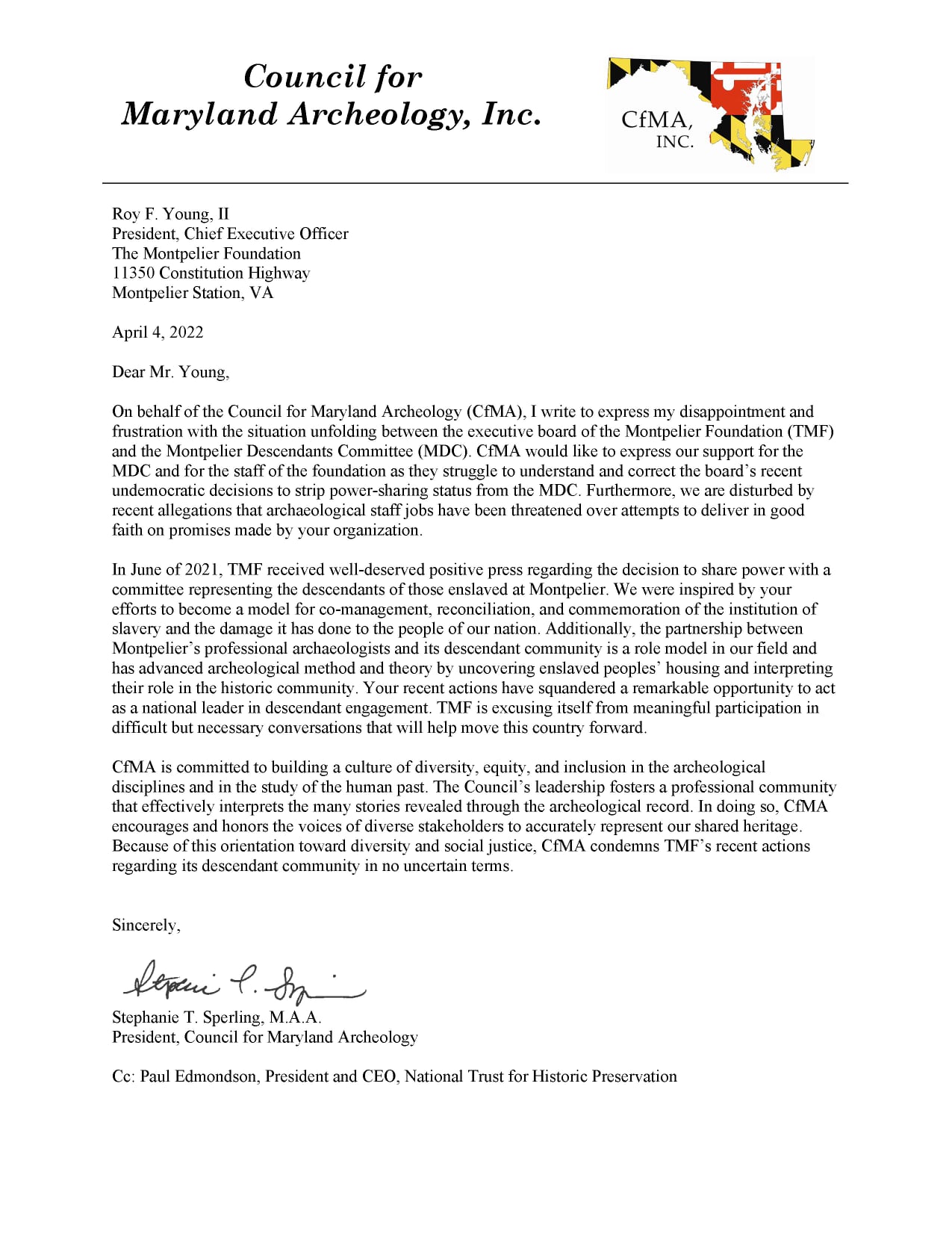
- Council of Maryland Archaeology, Inc. – Statement of Support
- Council of Virginia Archaeologists – COVA Letter of support to The Montpelier Foundation
- International Coalition of Sites of Conscience – Standing with Montpelier’s Descendant Community
- Middle Atlantic Archaeological Conference – Statement of Support of the Montpelier Descendants Committee
- National Council on Public History – NCPH Statement of support for the Montpelier Descendants Committee and Statement on Termination of Montpelier Staff
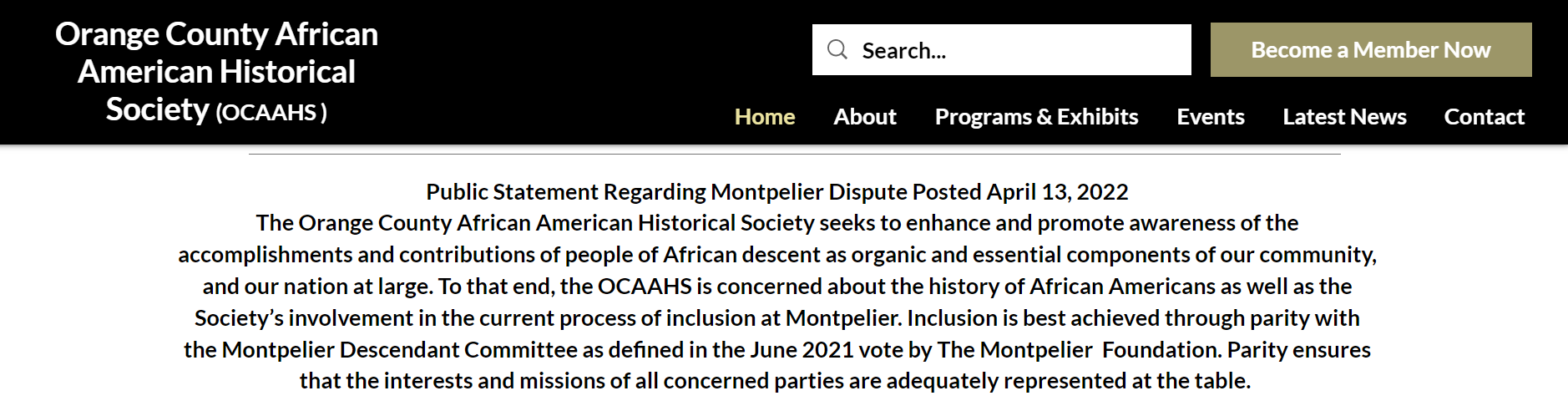
- Orange County African American Historical Society – Public Statement Regarding Montpelier Dispute
- Preservation Piedmont – Statement to the Montpelier Foundation Board
- President Lincoln’s Cottage – We stand with the Montpelier Descendants Committee
- Register of Professional Archaeologists – Statement of Support
- Society of American Archaeology – Statement of the SAA on the Recent Action by the Board of Directors of the Montpelier Foundation and Statement on Staff Dismissals
- Society for Historical Archaeology – Statement to the Montpelier Foundation
- Southeastern Archaeological Conference – Statement in support of the Montpelier Descendants Committee
- Virginia Association of Museums – The Virginia Association of Museums Releases Statement on Montpelier
- Wakasa Memorial Committee – Letter of support
Select Press Coverage
- Associated Press: “Madison estate rehires staff let go during recent turmoil,” (June 5, 2022) (also appears in the Washington Post, Bloomberg, and CBS 6 News)
- The Washington Post: “In reversal, Montpelier appoints directors from descendants of the enslaved,” by Gregory S. Schneider (May 16, 2022)
- The New York Times: “At Montpelier, Slaves’ Descendants Will Share Power With White Board Members,” by Alyssa Lukpat (May 16, 2022)
- The Washington Post: “Opinion: A revanchist assault on racial reforms in Virginia,” by the Editorial Board (May 4, 2022)
- C-Ville: “Luminaries jump into the fray,” by Courteney Stuart (May 4, 2022)
- The Daily Progress: “National Trust tells Montpelier board to seat nine MDC nominees immediately and without condition,” by Hilary Holladay (May 2, 2022)
- The New York Times: “At Madison’s Montpelier, a Fight Over Power for Slaves’ Descendants,” by Michael Levenson (April 22, 2022)
- The Washington Post: “James Madison’s plantation vowed to share power with black descendants. Then things blew up,” by DeNeen L. Brown (April 22, 2022)
- NPR: “Montpelier says it’s open to parity with slave descendants. Descendants cry foul,” Alana Wise (April 20, 2022)(also appears in MPR News, WAMU 88.5/American University Radio, and ncpr)
- ABC 8 News: “Montpelier staff fired amid fight over who should run James Madison’s home,” by Jakob Cordes (April 20, 2022)
- Esquire: “Let’s Not Throw Away the Progress Towards Historical Justice Made at James Madison’s Estate,” by Charles P. Pierce (April 19, 2022)
- Richmond Times-Dispatch: “First, Montpelier reversed its power-sharing promise with descendants of the enslaved. Now, it’s retreating from its history of enslavement,” Michael Paul Williams (April 19, 2022) (also appears in The News & Advance, The Culpeper Star-Exponent, and The Free Lance-Star)
- Culpeper Star-Exponent: “Nation’s history professionals deplore move by Madison’s Montpelier to walk back partnership pledge with Black community,” (March 31, 2022)
- Associated Press: “Montpelier ends power-share with enslaved descendants group,” (March 28, 2022)(also appears in U.S. News and World Report, Richmond Times-Dispatch, NBC 12 News, The Virginian-Pilot, CBS 6 News, amongst others)
- The Daily Progress: “Editorial: Montpelier fights over who controls the slaves’ story,” (March 28, 2022)
- Culpeper Star-Exponent: “James Madison’s Montpelier disempowers slave descendants, breaks promise,” by Clint Schemmer (March 27, 2022)(also appears in the Free Lance-Star and The Daily Progress)
- Augusta Free Press: “Montpelier descendants challenge massive resistance to power-sharing agreement,” (March 25, 2022)
- Washington Post: “James Madison’s Montpelier strips power from enslaved descendants group,” by Gregory S. Schneider (March 25, 2022)
Key Documents
Media Contact
-
Greg Werkheiser
Founding Partner
Cultural Heritage Partners, PLLC - 1717 Pennsylvania Avenue NW, Suite 1025 Washington DC, 20006
- (703) 408-2002
- greg@culturalheritagepartners.com