
Active Case
Protecting the Kennedy Center
- Active Litigation — DC Preservation League et al. v. Kennedy Center Board of Trustees et al. · Filed March 23, 2026
- About the Case
Unprecedented Coalition Sues to Require Federal Review of Kennedy Center Plans
Washington, DC — March 23, 2026 — A coalition of eight leading cultural heritage and architectural organizations jointly represented by three law firms filed suit in federal district court seeking to require the Trump administration to comply with historic preservation laws before implementing plans to alter the John F. Kennedy Center for the Performing Arts.
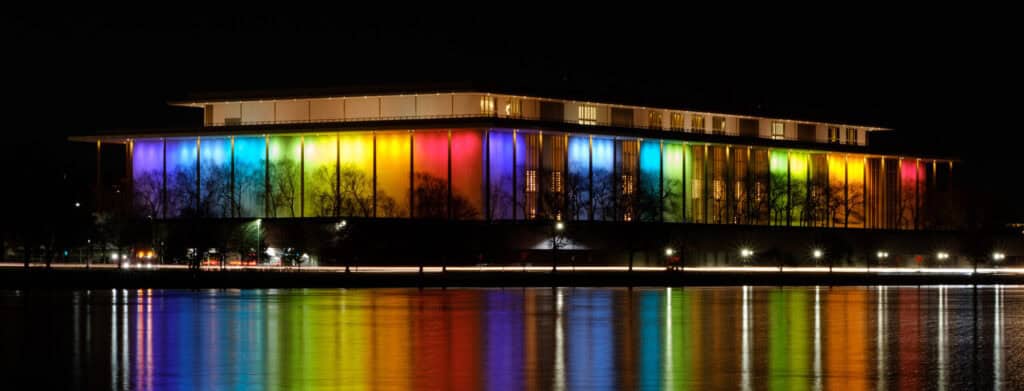
Photo of J. F. Kennedy Center for the Performing Rights By Der Berzerker from Washington, DC, USA – Kennedy Center, CC BY 2.0
The filing follows statements by President Trump that he may take the building “down to the steel” during a two-year closure beginning July 4, 2026. Plaintiffs cite the lesson learned when the President assured the American public that the East Wing of the White House would remain untouched during construction of his ballroom — and then approved its complete demolition.
Completed in 1971, the Kennedy Center is among the most prominent cultural institutions in the United States and an iconic architectural treasure. The building and grounds have been determined eligible for listing on the National Register of Historic Places, which triggers processes and protections under the National Historic Preservation Act (NHPA) and the National Environmental Policy Act (NEPA).
The complaint makes clear that plaintiffs do not challenge routine repairs and maintenance, for which Congress recently appropriated $257 million. Rather, plaintiffs seek to prevent irreversible harm to defining architectural and historic features without the process and authority required by law.
- Coalition Voices
What Leaders Are Saying
Latest Updates
PLAINTIFFS CALL FOR INDEPENDENT PROTECTION OF THE KENNEDY CENTER
Statement of eight Plaintiff organizations: The American Institute of Architects (AIA), American Society of Landscape Architects, Committee of 100 on the Federal City, The Cultural...
Greg Werkheiser on the Rachel Maddow Show
Greg Werkheiser, co-founder of Cultural Heritage Partners PLLC, appeared as a guest on the Rachel Maddow Show last night to discuss the unprecedented coalition of...
- Frequently Asked Questions
What is the Kennedy Center
The John F. Kennedy Center for the Performing Arts opened in 1971 as the nation’s living memorial to President John F. Kennedy. Located on the Potomac River in Washington, D.C., it serves as the United States’ national cultural center for the performing arts, hosting thousands of performances each year including theater, dance, opera, orchestral music, and popular music events. Many performances are free. The Millennium stage offers free performances 365 days a year, reaching 180,000 visitors in-person with upwards of 50 million views for livestream performances. Its 130,000 square feet of public gardens and paths support year-round public use and civic gatherings. The Kennedy Center hosts 2 million visitors a year, 1.6 million ticket buyers, 1.4 million students served, over 2,200 performances and exhibits, over 400 free performances and events.
The architecture was designed by Edward Durell Stone, Sr. and landscape architecture by his son, Ed Stone, Jr., along with Lester Collins and Sasaki, Walker and Associates. Design for the Kennedy Center incorporates many of Stone’s celebrated design elements, including a dramatic cantilevered roof supported by slender, gold-painted vertical columns—features that also appear in his design for the U.S. Embassy in New Delhi.
Why do preservation laws apply?
Elements of the Kennedy Center have been determined eligible for listing on the National Register of Historic Places. That status triggers federal review requirements under the National Historic Preservation Act (NHPA) and the National Environmental Policy Act whenever federal agencies propose actions that may affect historic resources.
What does the lawsuit argue?
The lawsuit alleges that the Kennedy Center Board and Trump administration are attempting to advance plans to dismantle or substantially alter the Kennedy Center without completing the legally required consultation and review processes. First, Defendants must secure permission of Congress for extensive design changes. Second, federal law requires agencies to consult with preservation experts, affected organizations, and the public before taking actions that could harm the integrity of historic resources. The suit also alleges anticipatory demolition: that by altering key elements of the building before seeking permits, the Kennedy Center Board has committed a violation, the remedy for which is that the permitting agencies are to deny permits, funding, and other assistance to the entire project.
Why does this case matter?
Cultural heritage and architecture advocates say the case raises broader questions about whether longstanding federal laws protecting historic landmarks will be followed when the government proposes major changes to nationally significant civic architecture.
Why is this lawsuit being filed now?
The lawsuit follows recent public statements by President Trump suggesting the Kennedy Center could undergo a dramatic renovation that would strip the building down to its steel structure, leaving the steel “fully exposed.” According to reporting, the administration is considering a two-year closure and a project that could cost at least $200 million. While officials say the effort is intended to address deferred maintenance and capital repairs funded by Congress last year, details about the scope of the proposed changes have not been publicly released. Preservation advocates say the possibility of such sweeping alterations—combined with limited public disclosure of the plans—makes it critical that federal agencies comply with the consultation and review processes required under the National Historic Preservation Act before any demolition or major reconstruction proceeds.
What happens next?
Plaintiffs will soon file a motion seeking a preliminary injunction and ask the court to hear it quickly given the speed with which the administration says it plans to alter the building.
How does this relate to the litigation over the attempted renaming of the complex the “Trump Kennedy Center?
The cases have different plaintiffs, legal counsel, and key legal theories, but both suits allege that the administration is shortchanging preservation laws and are seeking injunctive relief.
- About the Plantiffs
Eight Organizations. One Voice.
American Institute of Architects (AIA)
With 101,000 members, AIA is the world’s largest, most influential network of architects and design professionals. Founded in 1857, AIA consistently works to create more valuable, healthy, secure, and sustainable buildings, neighborhoods, and communities. Through more than 200 international, state and local chapters, AIA advocates for public policies that promote economic vitality and public wellbeing.
American Society of Landscape Architects
Founded in 1899, the American Society of Landscape Architects (ASLA) is the professional association for landscape architects in the United States, proudly representing more than 16,000 members. Landscape architects lead the planning, design, and stewardship of healthy, equitable, safe, and resilient environments.
Committee of 100 on the Federal City
Founded more than a century ago, the Committee of 100 on the Federal City is a nonprofit organization dedicated to safeguarding and advancing Washington’s historic distinction, natural beauty, and overall livability. The Committee’s work recognizes the critical value of public planning, informed by traditions that originate from the L’Enfant Plan and the McMillan Commission, continuing to the current day.
DC Preservation League
Founded in 1971, the DC Preservation League (DCPL) has played a major role in advocating for the preservation, protection, and enhancement of significant landmarks, neighborhoods, and cultural sites across all eight wards of Washington, D.C. The membership supported nonprofit carries out its work through advocacy, public education, and partnerships with government agencies and community groups.
Docomomo US
Docomomo US is the United States chapter of Docomomo International, a non-profit organization dedicated to the documentation and conservation of buildings, sites and neighborhoods of the modern movement. Committed to the principle that modern design merits the attention and preservation received by earlier periods, Docomomo US represents twenty-eight regional chapters and partner organizations that share knowledge of and enthusiasm for modern architecture, landscapes, and design.
National Trust for Historic Preservation
A privately-funded nonprofit organization dedicated to helping communities maintain and enhance the power of historic places. Chartered by Congress in 1949 and supported by partners, friends, and champions nationwide, the Trust helps preserve the places and stories that make communities unique. Through the stewardship and revitalization of historic sites, the Trust helps communities foster economic growth, create healthier environments, and build a stronger, shared sense of civic duty and belonging.
Society of Architectural Historians
Founded at Harvard University in 1940, SAH is a nonprofit membership organization that serves an international network of institutions and individuals who, by profession or interest, focus on the history of the built environment and its role in shaping contemporary life. SAH promotes the study, interpretation, and conservation of architecture, design, landscapes, and urbanism worldwide for the benefit of all.
The Cultural Landscape Foundation
(TCLF) is a 501(c)(3) non-profit founded in 1998 to connect people to places. TCLF educates and engages the public to make our shared landscape heritage more visible, identify its value, and empower its stewards. Through its website, publishing, lectures, and other events, TCLF broadens support and understanding for cultural landscapes. TCLF is also home to the Cornelia Hahn Oberlander International Landscape Architecture Prize.
Press Coverage:
Legal Filings (in reverse chronological order):
Expand to view all filings
- Plaintiffs’ Motion for Preliminary Injunction, filed March 30, 2026
- Memorandum in Support
- Proposed Order
- Declaration of Thaddeus A. Heuer
- Declaration of Rebecca Miller on behalf of the DC Preservation League
- Declaration of Carl E. Landwehr, DC Preservation League Member
- Declaration of Frank Leone, DC Preservation League Member
- Declaration of Zachary Joseph Burt, DC Preservation League Member
- Declaration of Amy Ballard, DC Preservation League Member
- Declaration of Elizabeth S. Merritt on behalf of the National Trust for Historic Preservation
- Declaration of Alison K. Hoagland, National Trust for Historic Preservation Member
- Declaration of Illya Azaroff on behalf of the American Institute of Architects
- Declaration of Diane Rhyu, Society of Architectural Historians Member
- Declaration of Yiselle Santos Rivera, Society of Architectural Historians Member
- Declaration of Patricia Ann Waddy, Society of Architectural Historians Member
- Declaration of James Aubrey Smailes, Committee of 100 on the Federal City Member and Trustee
- Declaration of de Teel Patterson Tiller, Committee of 100 on the Federal City Member and Trustee
- Declaration of Elizabeth Waytkus on behalf of DOCOMOMO US
- Declaration of John Allen Burns, DOCOMOMO US Member
- Declaration of Charles Alan Birnbaum on behalf of the Cultural Landscape Foundation
- Declaration of Caren Yglesias Livengood, American Society of Landscape Architects Member
- Declaration of Dennis Brian Carmichael, American Society of Landscape Architects Member
- Declaration of Susan Cahill-Aylward, American Society of Landscape Architects Member
- Exhibit 1
- Exhibit 2
- Exhibit 3
- Exhibit 4
- Exhibit 5
- Exhibit 6
- Exhibit 7
- Exhibit 8
- Exhibit 9
- Exhibit 10
- Exhibit 11
- Exhibit 12
- Exhibit 13
- Exhibit 14
- Exhibit 15
- Exhibit 16
- Exhibit 17
- Exhibit 18
- Exhibit 19
- Exhibit 20
- Exhibit 21
- Exhibit 22
- Exhibit 23
- Exhibit 24
- Exhibit 25
- Exhibit 26
- Exhibit 27
- Exhibit 28
- Exhibit 29
- Exhibit 30
- Exhibit 31
- Exhibit 32
- Exhibit 33
- Exhibit 34
- Exhibit 35
- Exhibit 36
- Exhibit 37
- Exhibit 38
- Plaintiffs’ Complaint filed March 23, 2026
Key Documents
Access the Public Docket
Press Coverage
Media coverage of the Kennedy Center lawsuit is being compiled and updated regularly.
About the Law Firms
Cultural Heritage Partners, PLLC (CHP)
Uses law, policy, and public attention to protect and preserve archaeology, art, architecture, landscapes, burial grounds, sacred spaces, traditional knowledge and practices, and related civil and human rights. The firm’s clients include Indigenous nations, African American communities, historic cities and towns, and cultural institutions globally. Since its founding in 2010, the firm has been led by Marion F. Werkheiser and Greg Werkheiser.
Foley Hoag
Award-winning, mid-sized, international law firm that focuses on innovative industries and high-stakes litigation. The firm maintains robust offices in Boston, New York, Washington, DC, Denver, and Paris. The diverse backgrounds, perspectives, and experiences of the firm’s lawyers and business services professionals contribute to the exceptional service Foley Hoag delivers to clients. Counsel in this matter are Greg Craig, Tad Heuer, and Matt Casassa.
Lowell & Associates, PLLC
Provides strategic, principled legal representation across civil, criminal, compliance, congressional, and regulatory matters. Led by its Founding Member, Abbe David Lowell, the firm’s mission is the provision of pro bono and public interest representation in matters that defend the integrity of the legal system and protect individuals and institutions from government overreach and other threats to fundamental rights.
Media Contact
-
Greg Werkheiser
Founding Partner
Cultural Heritage Partners, PLLC - 1717 Pennsylvania Avenue NW, Suite 1025 Washington DC, 20006
- (703) 408-2002
- greg@culturalheritagepartners.com